- Home
- Technology
- Applied Technologies for Products
- Technical Information


  |
 |
 |
 |
 |
  |


1. Introduction
Dial indicators are among the most popular dimensional gages widely used in various applications that include depth gages and thickness gages in addition to gaging fixtures, height stands, benchtop comparator stands, etc. Accordingly a wide variety of dial indicators are available to meet diverse requirements.
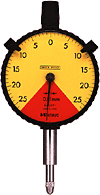
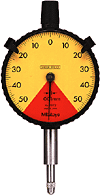
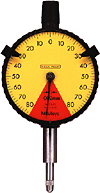
Of the varieties of dial indicatos one-revolution dial indicators have been specifically designed for comparison measurements with features that eliminate reading errors due to miscounting the number of revolutions of the pointer. They also feature a shock-proof mechanism. Because of these features one-revolution dial indicators have been introduced into the industry, especially the automotive manufacturers since their development in 1977. However, they were rather expensive and could not pave the way into global market.
This report introduces newly developed low-priced and high-reliable one-revolution dial indicators.
 |
 |
 |
|
No.2971 |
No.2972 |
No.2973 |
2. Development Concepts
Our major concerns in developing the new one-revolution dial indicators are enhanced quality, reliability, and environmental durability as well as low-pricing.
|
1) |
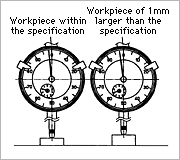
Measurement reliability : Preventing human errors Since the pointer does not turn more than one revolution, reading errors due to miscounting the number of revolutions of the pointer are eliminated. Indicators with double spaced scale interval are available for ease of reading. |
|||
|
[ Effectiveness of One-revolution Indicators ]
|

|
2) |
Long life, environmental resistance, dustproof mechanism |
|
The new shockproof mechanism protects the gear-train against quick spindle movement. High quality and high performance has been achieved with one piece molding of the dial cover and bezel and the spindle bushing inside the stem for preventing ingress of oil and dust contamination. |
|
3) |
Lightweight |
|
The weight has been reduced by approximately 40%. If used specifically with a bore gage, for example, the new indicator will help to reduce the operator fatigue in long usage. |
|
4) |
Cost reduction |
|
The employment of a new reinforced plastic molding material has achieved high reliability and drastically reduced the cost. |
3. New technologies
|
1) |
Plastic case molding |
|
|
|
2) |
One-piece case and bushing molding |
||||
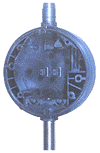
Having employed a plastic casting for the case, the bushing was also modified from the conventional brass casting to a plastic molding, permitting a one-piece guideway to be formed from a single material. This allows the spindle guide to be positioned inside the case and the stem to be clamped anywhere along its entire range. With this structure, spindle movement is not affected by dust/dirt, should it enter from the lower end of the stem.
|

|
3) |
Shockproof mechanism |
||||||||||||||
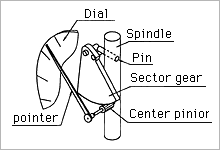
Of the conventional three magnification mechanisms, the pin magnification type was first employed for the 0.01mm graduation indicators. This shockproof mechanism has achieved high durability and high accuracy.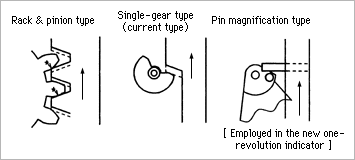
|
|
4) |
Plastic sector gear molding |
|
|

|
5) |
Hard coating |
|||||||||||||
The dial cover has been given a hard coating to improve scratch and oil (and other chemicals) resistance.
|

4. Specifications
|
||||||||||||||||||||||||||||||

The outline of the new one-revolution indicator has been given above. Mitutoyo will continue improving the cost-performance of standard indicators by applying the technologies that have been implemented in the new one-revolution indicators.
